Comparing Platforms for the Creation of Intelligent Agents
A systematic review of three major platforms using large-language models to create intelligent agents.



For the last several months, we have been testing and conducting research into platforms that enable the creation of large-language model supported virtual characters, or intelligent agents. This has yielded some very interesting results which we will share over several posts, but the first thing we wanted to create was a means of comparing and evaluating these platforms. In this post, we review three of the major platforms on the market today, all of which use GPT3, and share a systematic analysis of their capabilities in a spreadsheet we are making publicly available for your use.
Emoshape
Emoshape’s founder and CEO is the brilliant inventor Patrick Levi-Rosenthal who created Virtual Lens, the basis for the filters now widely used in social media applications like Snapchat and Instagram. He became convinced that the relationship between intelligent agents and humans would not prosper unless the agents could understand human emotions and react accordingly. He delved into the relationship between cognition and emotion and developed a new generation of microchips named Emotion Processing Unit enabling agents to feel a broad range of human emotions. Agents can express their emotions in their voices and facial expressions.
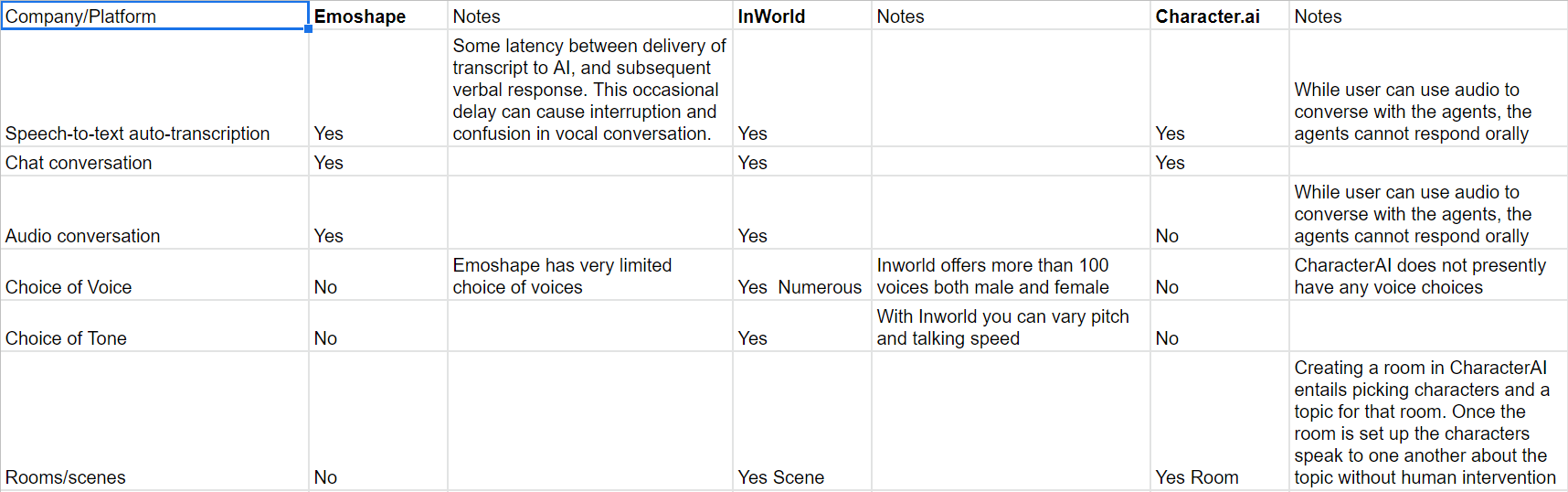
Emoshape enables the creation of emotionally sensitive agents that can be employed in a wide variety of roles. The emotional profiles are based upon Myers-Briggs personality types. At this time, the number of voices that can be used for agents is very limited. There is also a problem of latency with a delay in the auto-transcription of the user’s voice to text which is then delivered to the agent. This delay can cause conversational errors. Characters can be given avatars through an integration with ReadyPlayerMe, and can be placed in virtual environments off the Emoshape platform. All in all, Emoshape must rank as one of the most interesting platforms in the world of artificial agents.
Inworld
Inworld is another platform that offers several ways to create characters with a degree of emotional intelligence. It uses the Inworld Engine consisting of 20 AI machine learning and character models that enable agents to mimic human emotions. The user is presented with simple controls to configure his character’s personality including a character prompt and ability to add focal web links to tailor the personality and use of knowledge base. It is not, however, always easy to understand these options’ impact on the character. Inworld offers more than 100 voices both male and female and is engineered for low-latency performance. For now, the company is mainly focused on production of NPC (non-player characters) for video games but this does not prevent other use cases. Like Emoshape’s characters, Inworld enables the use of characters in any virtual environment, off platform.
Character.AI
Character.AI agents are based on large language models (like GPT-3) and oriented around text-based conversation. At present, there is no choice of voices. While there is a voice interface for the user, the agents do not reply vocally, but rather through text and image. The company provides users with a detailed Character Book which is a step-by-step guide to creating an agent but does not provide any way of infusing the agent with emotional intelligence. One of the most unusual features of the characters is the ability of some characters to create relevant images during the conversation. Users have the option to chat with already created characters like Librarian Linda or Elon Musk who will answer questions from the appropriate database of responses related to their special skill set; Librarian Linda has a deep knowledge of books and Elon Musk knows about Tesla and Twitter. Unlike both Emoshape and Inworld, Character.AI’s agents are currently only hosted on the platform, and cannot be brought into other virtual environments.
In addition to these highlights, we developed a spreadsheet feature set comparison for these platforms. We are making it publicly available as a Google spreadsheet for you to copy and expand upon for your own purposes. We will be keeping our original updated and expand it as we explore additional platforms, and will post relevant updates as they emerge.